The remarkable color diversity observed in Crested Geckos is primarily a result of their polygenic inheritance. These geckos can express base colors individually or in combination. Through selective breeding, breeders have established "pure" color lines (homozygous forms expressing two copies of a single base color allele), as well as hypo forms (heterozygous for a single base color allele), and a vast spectrum of other color combinations. The color chart to the right illustrates all possible base color combinations; however, the actual diversity is nearly double this due to the impact of coverage (discussed below).

Y/R/B
Yellow, Red, and Black

The image to the left visually represents potential base color combinations, with each half-circle symbolizing an allele, a unit of inheritance passed to offspring. In this depiction, all three base colors are present in homozygous form (shorthand: 2/2/2). A half-empty circle indicates that the gecko is heterozygous for that specific base color, while an entirely white circle signifies the absence of that base color and its corresponding phenotypic effect. These various combinations can manifest in diverse ways, influenced by the specific base color(s) present, the presence of other base colors, and whether the gecko exhibits the Phantom morph or has coverage.
The Physical arrangement
Layering
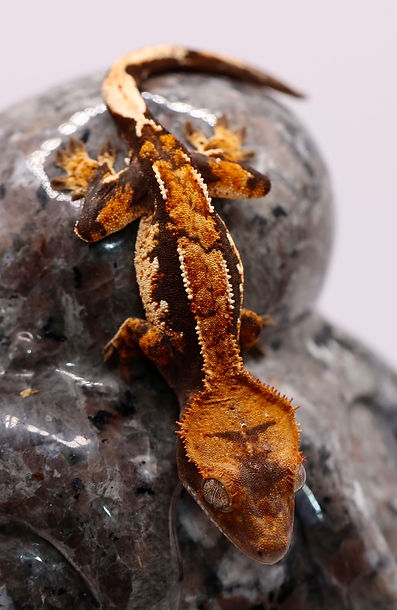
The gecko pictured to the right clearly exhibits the influence of a Yellow base color. However, the patterning provides valuable insights into the presence of other base colors. In this instance, we observe a significantly darker dorsal region and darker mottling beneath the crest, along the sides, and on the legs. In this way, pattern (Pinstripe and/or Tiger) acts to "push aside" the uppermost layer of yellow pigment, revealing underlying colors. Given its lineage, we know this gecko carries at least one allele for Red. However, the dark nature of the pinstripe areas suggests the likely presence of at least one Black allele as well. Upon closer inspection, these patterned areas indeed reveal a Dark Red hue, placing this gecko in the (2/1/1) category for the Phantom morph.


The reasoning for the above mentioned layering of Crested Gecko Base Colors lies in the physical arrangement within their skin. The units of Color (Chromatophores) are layered in such a way that Yellow is on the top, Red in the middle, and Black on the bottom. Other structures (iridophores) are largely responsible for the "firing" (brightening/darkening) that this species is capable of exhibiting. A more in depth discussion, studies pertaining to this topic, and sited references is available here.
Coverage
Its impact and misunderstanding
Coverage (historically termed "Harlequin"), defines non-phantom crested geckos by the presence of pigmentation patterns in the dorsal and lateral "Harlequin regions." Since the hobby’s inception, Coverage has been highly selected for and now represents the large majority of the captive population; however, this was not the case in the early days. Initially, Phantoms were the vast majority of phenotypes (>95%) and currently represent the wild-type phenotype, which is defined as representing the larger majority of the native population. The key to understanding Coverage’s impact is understanding its effect on the yellow base color. Simply put, Coverage segregates a yellow base color allele into the Harlequin regions, thus creating what is referred to as the “Harlequin colors,” or orange and white pattern. Fortunately, this relationship between the Coverage gene and the yellow base color genes can be easily proven through properly tracking lineage and assigning Base Colors as discussed above.
The most striking evidence is that all non-phantom yellow-based geckos have the ability to produce phantoms directly. The reason is that while one copy of the Coverage allele affects a single yellow base color, a second yellow base color allele is present and unaffected by a second Coverage allele. Thus, the resulting gecko is heterozygous for Coverage (previously understood as “Het Phantom”). Similarly, red-based non-phantoms without high levels of coverage will be able to produce phantoms directly. In the red-based scenario, there is a chance that Coverage is present in homozygous form; however, these individuals will exhibit a higher level of orange and white pattern than their phantom-producing counterparts.